Gallatin Faculty Stands in Solidarity with Divest
Letter to the Editor, Washington Square News, April 29, 2016
Last week we witnessed what we as educators love the most: students using their creativity and analytical thinking skills to act politically and support a cause in which they believe. NYU Divest made their case to the administration for why our university should divest from fossil fuels, and why the university should be part of a transparent decision process. Their call was in line with an overwhelming vote by the faculty senate last year and a recent letter signed by over 200 faculty members. They also asked that our new leadership should respect what our former president John Sexton had promised them in writing, namely to let the students present their case at NYU’s board meeting.
The venue they chose was both original and humorous: they staged their protest in the administration elevator in Bobst, tweeting #RiseWithUs. Instead of engaging the students in a meaningful way on issues of transparency and keeping the promise of a meeting with the board, the administration copied the students’ photo IDs, threatened them with disciplinary action (including immediate suspension) and contacted their parents.
While university disciplinary procedure might allow for immediate suspension in exceptional circumstances, this approach strikes us as heavy-handed and unnecessary. In times of conflict, our students should be treated as young adults, not as kids in need of parental supervision. Yet our point is not so much about NYU procedure, but culture. What the administration has created is an atmosphere of fear among our students where there should be safety and tolerance. We, as faculty at NYU’s Gallatin School of Individualized Study, take pride in our students’ commitment to addressing issues that are important for our university and the world.
Peder Anker, Sinan Antoon, Gianpaolo Baiocchi, Paula Chakravartty, Anne DeWitt, Valerie Forman, Andrea L Gadberry, Hannah R Gurman, Louise Harpman, Mitchell Joachim, Ritty Lukose, Amanda K Petrusich, Kim Phillips-Fein, Mark Read, Greg Vargo, Alejandro Velasco
My review of Eco-Cultural Networks and the British Empire

Art in the Anthropocene

“Art in the Anthropocene,” in Jan Freuchen: Columna Translantica, (Oslo: Press, 2015), 112-121.
Global warming is now at the forefront of public debate, along with a host of related environmental concerns. Indeed, humans are changing the face of the earth so dramatically that geologists use the word “anthropocene” to describe a new planetary epoch formed by human impact. Artists have increasingly begun reflecting on how to engage in the climate debates about the degradation of our shared environment. Jan Freuchen’s Columna Transatlantica may belong within this new school of environmental art.
Download article in English here or Norwegian here.

A pioneer country? A history of Norwegian climate politics

“A pioneer country? A history of Norwegian climate politics” Climatic Change, (Online March 2016), 1-13. Journal edition 151:1 (2018), 29-41.
Download PDF.
The shift away from ecology towards climatology in Norwegian environmental policy in the late 1980s and 1990s was not accidental. A main mover was the Labor Party politician Gro Harlem Brundtland who did not want to deal with unruly and highly vocal Deep Ecologists. Better then to start afresh with a different set of environmental scholars appealing to the technocratic tradition within the Labor Party. Instead of changing the ethical and social ways of dealing with environmental problems as the Deep Ecologists were advocating, she was looking for technological and economic solutions. And she mobilized an international regime of carbon capture storage (CCS), tradable carbon emissions quota (TEQs), and clean development mechanisms (CDMs), all of which eventually were approved in Kyoto in 1997. This move towards technocracy and cost-benefit economics reflects a post-Cold War turn towards utilitarian capitalism, but also a longing to showcase Norway as an environmental pioneer country to the world. The underlying question was how to reconcile the nation’s booming petroleum industry with reduction in climate gas emissions. Should the oil and gas stay underground and the country strive towards the ecologically informed zerogrowth society the Deep Ecologists were envisioning? Or could growth in the petroleum industry take place without harming the environment as the Labor Party environmentalists argued?
TechStyles: The Gallatin Fashion Show

TechStyles: The Gallatin Fashion Show will offer an examination of how fashion is inspired by science and technology, with sixteen collections from Gallatin students and alumni. TechStyles: The Gallatin Fashion Show will feature looks that take some heat from Steampunk, find God in the machine, suit up for Utopia, as well as offering meditations on stardust and bioluminescence and other phenomenon of the natural world. Q&A: Colby Jordan and Peder Anker.
Mar. 3 | 7:00 – 9:00 PM | The Jerry H. Labowitz Theatre for the Performing Arts | Gallatin School of Individualized Study, 1 Washington Place, New York.
Closed Worlds: Encounters That Never Happened
Me (as Niel Armstrong) at 14:05
Closed Worlds: Encounters That Never Happened
The image of Earth from outer space was highly anticipated throughout the 1960s, and inspired a great deal of wonder in the general population. This iconic image reached the apex of its symbolism in 1968, through the famous Earthrise series taken by Apollo 8. Portraying mankind entrapped in the finite space of a sphere, the image of Earth as perceived from space may be accountable, in part, for a feeling of anxiety in our collective cultural imagination. It resulted in the development of broad literature that projected plans for our future survival within what Buckminster Fuller famously called our ‘spaceship earth’. Reyner Banham, with an environmental bubble; Hans Hollein, with a pill illustrating that “all is architecture”; Jacques Cousteau, with the Conshelf project that explored the inner space of the ocean; and Walt Disney, with EPCOT as a reconstruction of a miniaturized and idealized world, among others, have contributed substantially and in various ways to the discourse of closed worlds.
Feb 27th 12-6 pm, The Cooper Union. Encounters That Never Happened is presented in conjunction with Closed Worlds, an exhibition on view at Storefront for Art and Architecture.
Envision: Nature and Design
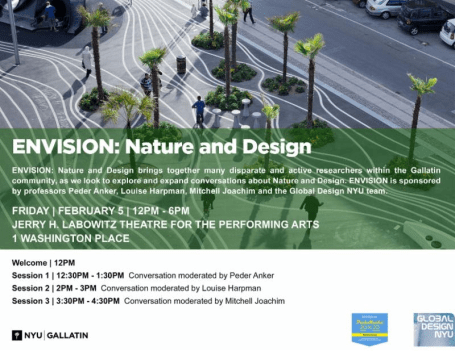
ENVISION: Nature and Design, sponsored by Global Design NYU, creates an exciting dialogue with many disparate and active researchers within the Gallatin community, as we look to broaden the horizons on the meanings of Nature and Design.
The event is a structured presentation format where presenters show 20 images, each for 20 seconds. The images advance automatically to coordinate with the speaker, creating a fast-paced and lively environment for showcasing current work. Powered by PechaKucha.
With Jack Richards, Jack Tchen, Katherine O’Kelly, Carly A Krakow, Matt Stanley, Marie Cruz Soto, Lauren M Walsh, Anooradha Iyer Siddiqi, Fran White, Leila Buck, Judith Sloan, Piper Anderson, Frederic Clark, Carter Bird, and Karen Holmberg. Organized by Peder Anker, Mitchell Joachim and Louise Harpman.
There is no Planet B

NYU Supports Climate Deal Now!

Global Design: Elsewhere Envisioned
 Peder Anker, Louise Harpman, Mitchell Joachim, Global Design: Elsewhere Envisioned (Munich: Prestel, 2014).
Get the book:

This book examines the possibilities for scaling design solutions to address global warming.
Global warming poses new challenges to the architecture, landscape architecture, and urban design communities. The immediate response has been a turn toward a host of energy-saving technologies. What has rarely been addressed, however, is the problem of scale. How can designers make sure that global solutions do not come at the expense of local cultures and environments? By placing human rational, emotional, technological, and social needs at the center of our environmental concerns, this book proposes a new global design initiative. The aim is to develop a language of design that can create proximity between individual responsibility and the current global environmental crisis. These featured projects showcase leading-edge design innovations at multiple scales. Global Design directors Peder Anker, Louise Harpman, and Mitchell Joachim discuss various ways in which design can reformat the unfortunate separation between humans and the natural world.
Review
Shaunacy Ferro, “7 Ways Architecture Can Tackle Global Warming” at FastCompany, Feb. 2015.


 Peder Anker