Anthropocene Architecture: Design Earth’s Geostories

“Anthropocene Architecture: Design Earth’s Geostories” with Nina Edwards Anker, The Avery Review 29 (Feb. 2018). [PDF]
Republished in: Rania Ghosn and El Hadi Jazairy, Geostories: Another Architecture for the Environment, (Barcelona: Actar, 2018), 206-213.
A review of the exhibition Geostories: Another Architecture for the Environment, created by Rania Ghosn and El Hadi Jazairy, which was on display at the Cooper Union School of Architecture in New York, October 17, 2017–December 2, 2017.
The London Bauhaus Designed a Socialist Utopia for Penguins
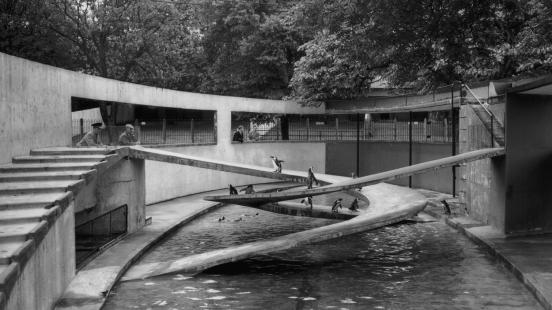
The 20th-century German design movement is often associated with tubular chairs and streamlined workspaces, but the Bauhaus was invested in the natural kingdom from the start.
“The London Bauhaus Designed a Socialist Utopia for Penguins,” interviewed by Erin Schwartz for the Garage Magazine, Feb. 5th, 2018.
Why Slow Architecture Is Quickly Catching On
Slow architecture will incorporate all the available technologies of sustainable design, such as solar cells, geothermal heat exchange systems, and energy efficient materials. Why not be good to the environment and cut down the electric bill at the same time?
Why Slow Architecture Is Quickly Catching On, The Purist, April 30, 2017.
School of the Earth

Peder Anker and Mitchell Joachim (eds.) School of the Earth: Gallatin Reimagined in 2061, (New York: Gallatin School, 2017).
School of the Earth is a vision for what the Gallatin School of Individualized Study at New York University should be like in 2061 at Albert Gallatin’s 300th birthday. The envisioned new school is designed with our planet in mind. It is a school designed to fit the local ecosystem. This book was born from a dedicated class of students lead by professors Peder Anker and Mitchell Joachim. Humans have done enough taking, the students argue, and it is time to start giving back. Giving back to our planet and each other. The world is more connected than ever before and it is only going to become increasingly more intertwined and complicated. School of the Earth is about the necessity of connection, not only from human to human but between nature and people as well. The new vision for the Gallatin School is complete with visionary images and a model created to educate students and the public that not only is it possible for humans to exist while giving back, but that we can help make the planet a better, healthier place for the future as well.
The book, the exhibition, the model, a film, a published manifesto in Confluence, and the web site were the final results made by students of the class “Designing for New Climates: Histories of Adaptation” co-taught with Mitchell Joachim.
Get the book: US $ | GBP £ | EUR €
In the news: WSN and WSN editorial
The Closed World of Biosphere 2
The Closed World of Biosphere 2: Why an Eccentric Ecological Experiment Still Matters 25 Years Later, Edge effects, Dec. 15, 2016.
Including an exchange with Mark Nelson, May 2017.
Human Heliostat NYU
Producers: Louise Harpman, Peder Anker, Keith Miller, Mitchell Joachim. Director: Keith Miller. Actor: Priya Patel. Camera: Adam Golfer, Thomas Lau. Editor: Charles Chintzer Lai. Photography: Ivan Specht. Music: DJ Spooky. Production Assistants: Louisa Nolte, Rachel Stern. Participants: Cynthia Allen, Liz Appel, Jamie Berthe, Honor Bishop, Michelle Boukhover, Colin F Brett Nina R Demeo, Pasan Dharmasena, Jacob Ford, Hallie M Franks, Hannah Fullerton, Jason Gabaee, Aaron Gartenberg, Vince Gaudio, Subhankar Ghosh, Celine Rose Gruenberg, Georgina Hahn-Griffiths, Michael Hirschorn, Kristin Horton, Gisela Humphreys, William Kammler, Zoe A Kennedy, Sage Mastakouras, Stacie McDonald, Louisa Nolte, Celeste Orangers, Brennan O’Rourke, Annie Pluimer, Caroline Porter, Alejandro Ribadeneira, Kyle Richard, Arielle Ross, Henry Sheeran, Ivan Specht, Rachel N Stern, Luke Thurmond, Greg Vargo, Aleksei Waddington, John Wedge, Jen Weitsen.
Untangling Intentions: Teaching the History of Climate Politics
 “Untangling Intentions: Teaching the History of Climate Politics,” in Teaching Climate Change in the Humanities, Stephen Siperstein, Shane Hall and Stephanie LeMenager (eds.), (New York: Routledge, 2016), 272-278. [PDF]
Ouroboros Architecture

“Ouroboros Architecture,” in The Routledge Companion to Biology in Art and Architecture, Charissa N. Terranova and Meredith Tromble (eds.), (New York: Routledge, 2016), 112-135.
This article explores how and why imagined and real environments in space came to serve as models for ecological design of earthly landscapes and buildings in the 1970s. It claims that life in space came to represent the peaceful, rational, and environmentally friendly alternative to the destructive, irrational, ecological crisis down on Earth. Spaceship management aimed narrowly at the biological survival of astronauts, an ethic which also came to dominate ecological design proposals on board Spaceship Earth. The result was a design programme which was at the expense of a wider aesthetic and social understanding of the human condition. The article reviews the work of leading ecological designers of the period, such as Ian L. McHarg, John Todd and the New Alchemists, Alexander Pike and John Frazer, Brenda and Robert Vale, Ken Yeang, Phil Hawes, and others. It situates their projects in the perspective of ecological research methods of the period and puts forward an understanding of their thinking in the context of space exploration. Today’s challenge is to escape the intellectual space capsule that ecologists have created for environmentally concerned architects.
DLD: Creative Hubs Around the Globe
Creative Hubs Around the Globe, DLD moderator for panel discussion with Stefan Franzke, John Battelle, and Maryanne Gilmartin. May 4th 2016.
What is a “creative hub”? And what are the necessary factors to make them happen? Certainly, they don’t come out of nowhere, or do they? If not, what factors are of key importance? One or several of these factors play a role: business opportunities, real estate, cultural life, security, access to capital, know-how and universities, and, perhaps, politics. Why do some cities succeed? And why do some creative hubs fade away? And which role does the digital economy play, if any?
Times Square Electronic Garden
The “Times Square Electronic Garden” project initiated a conversation about climate change, energy use and green urban spaces. Designed and fabricated by New York University students, this earth bomb featured speakers and live sensors among the plants that connected to our URL. The idea was to “re-nature” Times Square so that the public can contemplate new natures within our cities. We invited people to explore soothing living vegetative surfaces and recognize the stark contrast of their hyper-electrified surroundings. The students designed and built an open central sphere for visitors to circulate through so that they could encounter a microcosm of hanging gardens. Around the sphere we created a greenscape of serpentine living benches for rest, gathering, and contemplation. The whole project, start-to-finish, was erected and removed in a 24 hour period on May 10th, 2016. It was a place to reimagine Times Square’s consumer culture into a truly sumptuous environmental future.

Co-Principal Investigators: Mitchell Joachim, Louise Harpman, Peder Anker. Film Media: Keith Miller. NYU ITP: Namira Abdulgani, Kylin Chen, Ella Dagan, Jordan Frand, Michelle Hessel, Renata Kuba, Gal Nissim, Isabel Paez, Tigran Paravyan, Lutfiadi Rahmanto, Leslie Ruckman, Abhishek Singh, Edson Soares, Katie Temrowski, Jed Watson, Yan Zhao, Yang Zhao. NYU Gallatin: Theo Mandin-Lee, Jordan Marks, Max Mezzomo, Valerie Mu, Shel Orock, Alex Selz, Henry Wang. NYU Staff: Karim Ahmed, Jenny Kijowski, Nicholas P Likos, Lillian J Warner, Matthew Tarpley, Shandor Hassan, Shai Pelled.
Sponsored by: GDNYU, NYU Gallatin School, Times Square Alliance, NYCxDESIGN, NYU Tisch.


 Peder Anker