Posts filed under ‘Home’
Saving Nature: Religion as Environmentalism, Environmentalism as Religion

Tarjei Rønnow
Saving Nature
Religion as Environmentalism, Environmentalism as Religion, Lit Verlag, 2011
In 2009 my friend Tarjei Rønnow died suddenly of heart failure, 41 years old, leaving his two beloved sons, along with his companion, family, and a large group of friends behind. Words cannot express the sorrow I feel for this terrible loss. Among his numerous writings he left us an unfinished manuscript for his Ph.D. thesis, which I have edited so that it could become available to the public. It is my hope that his theses will inspire others in the same way it in numerous ways has inspired me.
Saving Nature approaches environmentalism as a belief system. It explores the impact of environmentalism on faith communities and vice versa, and analyses how environmental worldviews, values, attitudes and discourses affect religion. By drawing on sources in the sociology of religion and environmental sociology, the study sheds light on the religious dimensions of environmentalism. Rønnow locates the quick growth of environmentalism in the history of allegedly secular modernity, and interprets environmentalism in the context of modernity’s re-sacralization.
My review of Merchants of Doubt
 Naomi Oreskes and Erik M. Conway. Merchants of Doubt: How a Handful of Scientists Obscured the Truth on Issues from Tobacco Smoke to Global Warming.
Isis, 102:3 (2011), 589-590.
Design Collaboration with NEA Studio
Roof shelter for a water taxi/ferry in Manhattan based on scientific theories designed with Nina Edwards Anker at nea studio.
Winner of the New York State Council of the Arts, Design Award in 2003.
Roof Shelter for Red Hook, Brooklyn


 The roof shelter at a pier for a water taxi/ferry will facilitate communication between Red Hook and the rest of the city. The design seeks to explore organic rationality. The shelter has three aims: (1) to register times, (2) to filter climatic comfort, and (3) to provide a marker for the community.
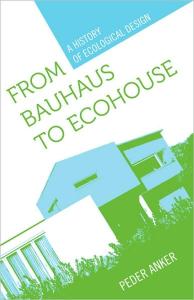
From Bauhaus to Ecohouse: A History of Ecological Design
Click for information
Global warming and concerns about sustainability recently have pushed ecological design to the forefront of architectural study and debate. As Peder Anker explains in From Bauhaus to Ecohouse, despite claims of novelty, debates about environmentally sensitive architecture has been ongoing for nearly a century. By exploring key moments of inspiration between designers and ecologists from the Bauhaus projects of the interwar period to the eco-arks of the 1980s, Anker traces the historical intersection of architecture and ecological science and assesses how both remain intertwined philosophically and pragmatically within the still-evolving field of ecological design.


 Peder Anker