Posts tagged ‘nature’
Coding Plants
Coding Plants: An Artificial Reef and Living Kelp Archive
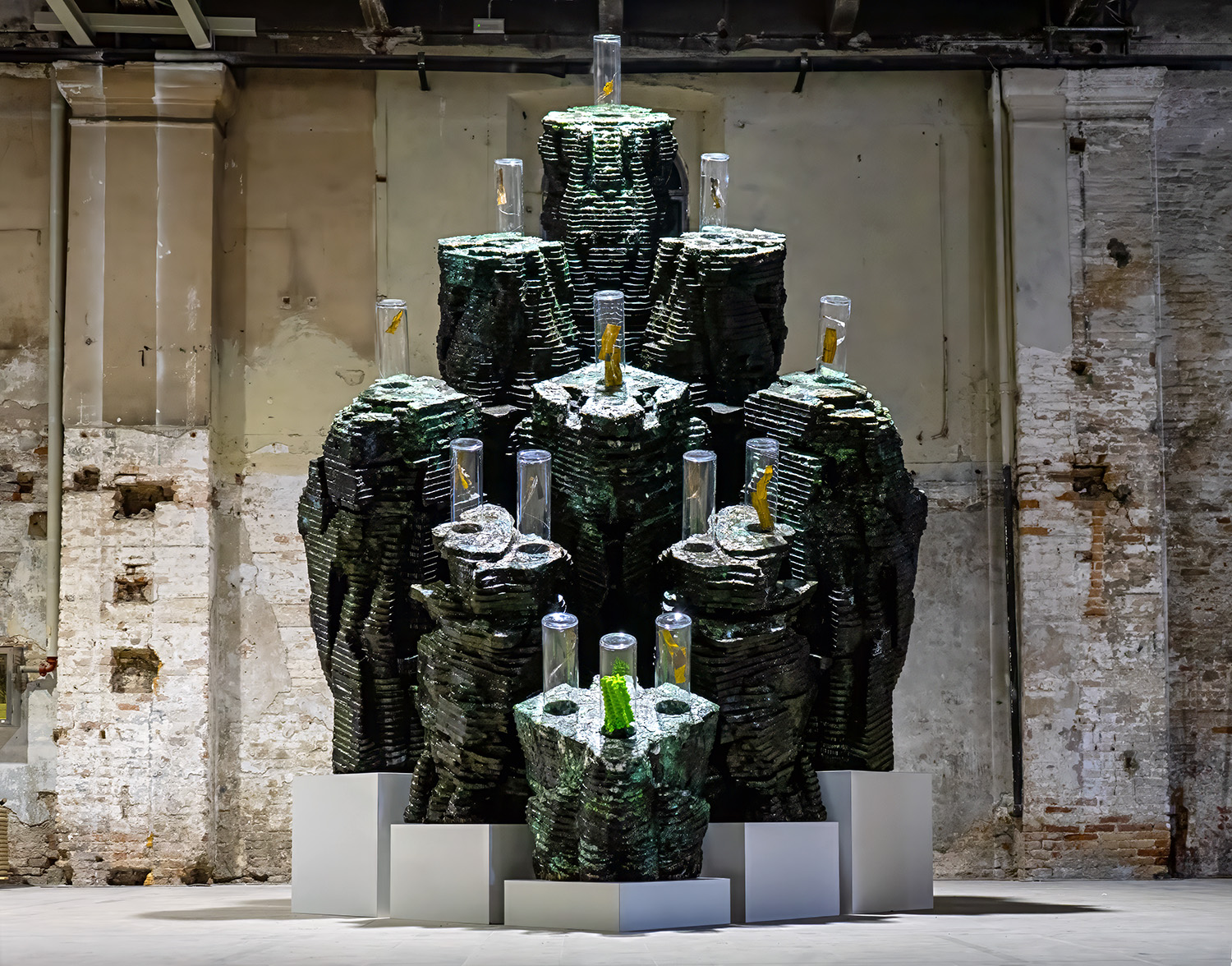
19th International Architecture Exhibition: Intelligens. Natural. Artificial. Collective.
Venice, May 10 – Nov. 23, 2025.
This is a neo-natural kelp reef where architectural records are transformed into edible proteins. Encased in air-tight vitrines, a collection of suspended, dried seaweed specimens showcases a transgenic process. Scientists have embedded encoded information—texts, images, and drawings—directly into the genetic material of this engineered vegetation, effectively turning the reef into a living, edible library. The 3D model at the center of the reef physically represents the phrase Form Follows Function, ciphered in the AGTC sequence of DNA. This exhibition is accompanied by the sound composition Earth Ocean, by Paul D. Miller aka DJ Spooky.
The title Coding Plants reflects our vision of embedding digital information into living systems to transform how we design and build. A single gram of plant DNA can theoretically store up to 215 million gigabytes of data. The project articulates a dual premise: the encoding of semantic and spatial information within botanical systems, and the broader implication of living matter as programmable infrastructure. While kelp is technically a macroalgae, not a plant, we use the term “plants” broadly—referring both to botanical life and to systems of production, as in “manufacturing plants.” Kelp serves as our transgenic prototype due to its ecological value and its potential for DNA-based data storage. The name signals a future in which living organisms—plant or otherwise—become computational, functional elements of architecture.
In the future, libraries won’t be built, but grown. Botanical organisms will be genetically augmented to store the knowledge of specific architectural forms—houses, bridges, communal spaces, and more—that can be extracted and used to challenge polluting construction methods. The goal is to design urban environments that adapt and evolve in balance with their surrounding metabolism. Plants will function as living archives, encoding detailed information within their DNA, allowing users to guide and influence their growth and structural form. This approach integrates radical sustainability directly into a semi-natural ecosystem, creating a harmonious blend of hybrid nature and human innovation.
Coding Plants is a synthetic living reef that serves as the ultimate archive of design knowledge. By embedding complex architectural intelligence into live organisms, Coding Plants proposes a climate positive agenda in which nature is empowered at the genetic level. While this vision may appear speculative, it is grounded in recent breakthroughs in genetic engineering. This approach heralds a fertile architecture that reimagines conventional building practices while fostering resilience, adaptability, and ecosystem integration.
Publications
“Coding Plants,” Intelligens. Natural. Artificial. Collective: Exhibition Catalogue, Carlo Ratti (ed.)(Venice, IT: Biennale Architectura, 2025), 100.
“Coding Plants” e-flux architecture, May 8, 2025.
Press
«20,000 Files Under the Sea,» NYU News, July 30, 2025.
“In Venice, an Architecture Biennale with a Dystopian Flair“, Architectural Record, May 30, 2025.
“Maybe Venice is the city that can save the world, BBC, May 26, 2025.
“Apre la Biennale di Venezia,” Interni, May 9, 2025.
“La mostra Intelligens,” Elle decor, May 10, 2025.
“Harvard Graduate School of Design Community Makes a Strong Showing at the 2025 Venice Architecture Biennale,” GSD News, May 9, 2025.
Credits
Project: Terreform ONE, Mitchell Joachim, Peder Anker, Melanie Fessel, Paul D. Miller (aka DJ Spooky). Studio: Vivian Kuan (Executive Director), Julie Bleha. Design: David Paraschiv, Emily Young, Sky Achitoff, Avantika Velho, JJ Zhijie Jin. Science: Sebastian S. Cocioba, Chris Woebken, Oliver Medvedik. Collaborators: Wendy W. Fok, WE-DESIGNS. Media: Michelle Alves De Lima. Research: Nicholas Lynch, Ava Hudson, Marina Ongaro, Jerzelle Lim, Helen Gui. Sponsors: U.S. National Endowment for the Arts, Global Research Initiatives, Office of the Provost, New York University. Global Design NYU, Gallatin School of Individualized Study, New York University. Oslo School of Architecture and Design. RheinMain University of Applied Sciences. Special Thanks: Carlo Ratti, Curator of the 19th International Architecture Exhibition. Victoria Rosner, Dean of Gallatin School of Individualized Study at New York University.
My Interview in Adam Curtis’ BBC TV Documentary
 All Watched Over by Machines of Loving Grace
2. The Use and Abuse of Vegetational Concepts
Article in The Observer “How the ‘ecosystem’ myth has been used for sinister means” by Adam Curtis. Check also out this Curtis interview and documentary Wikipedia page.
Broadcast on BBC Two, 9:00 p.m. Monday, 30 May 2011: A series of films exploring the idea that we have been colonised by the machines we have built. Although we don’t realise it, the way we see everything in the world today is through the eyes of the computers.
This is the story of how our modern scientific idea of nature, the self-regulating ecosystem, is actually a machine fantasy. It has little to do with the real complexity of nature. It is based on cybernetic ideas that were projected on to nature in the 1950s by ambitious scientists. A static machine theory of order that sees humans, and everything else on the planet, as components – cogs – in a system.
But in an age disillusioned with politics, the self-regulating ecosystem has become the model for utopian ideas of human ‘self-organizing networks’ – dreams of new ways of organising societies without leaders, as in the Facebook and Twitter revolutions, and in global visions of connectivity like the Gaia theory.
This powerful idea emerged out of the hippie communes in America in the 1960s, and from counterculture computer scientists who believed that global webs of computers could liberate the world.
But, at the very moment this was happening, the science of ecology discovered that the theory of the self-regulating ecosystem wasn’t true. Instead they found that nature was really dynamic and constantly changing in unpredictable ways. But the dream of the self-organizing network had by now captured our imaginations – because it offered an alternative to the dangerous and discredited ideas of politics.
Check out Stephen Duncombe’s excellent piece “Adam Curtis: Dystopian Dialectics, ” Photoworks, Jan 15, 2014.
Teaser:


 Peder Anker