Posts tagged ‘architecture’
Burning Down the House
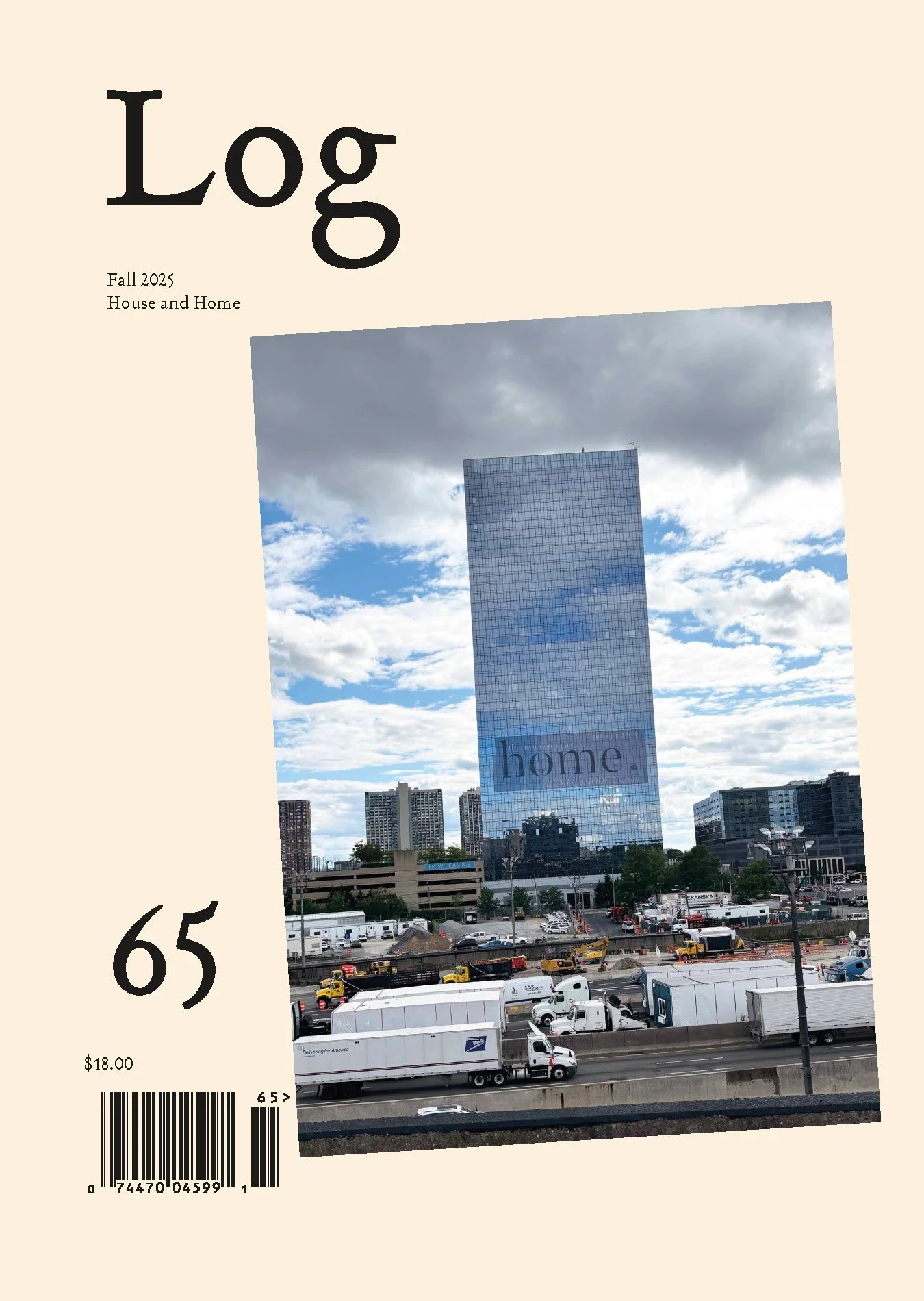
“Burning Down the House,” with Mitchell Joachim, Log 65 (2025), 79-85.
Hold tight
We’re in for nasty weather
There has got to be a way
Burning down the house.
Get Log 65 here.
Coding Plants
Coding Plants: An Artificial Reef and Living Kelp Archive
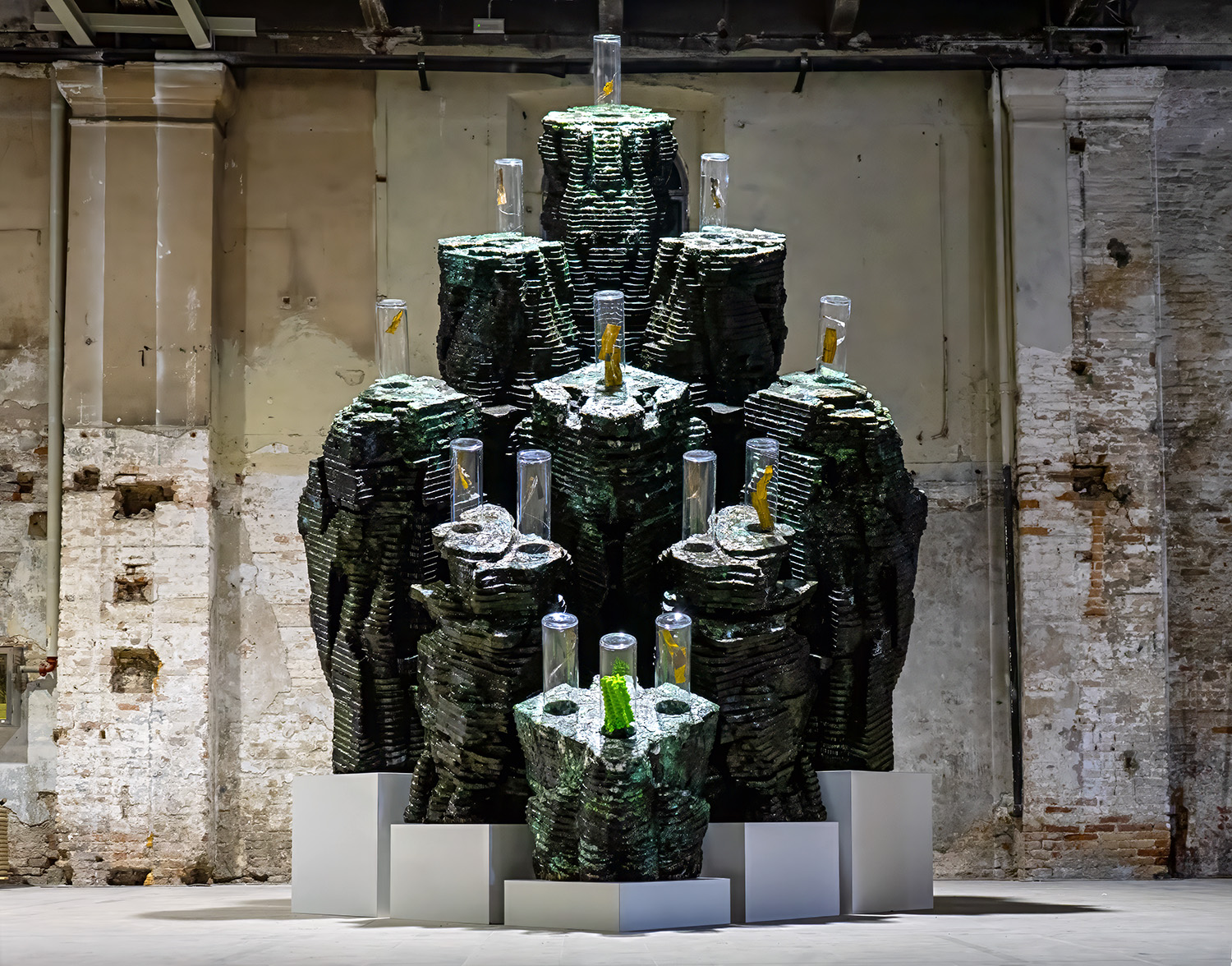
19th International Architecture Exhibition: Intelligens. Natural. Artificial. Collective.
Venice, May 10 – Nov. 23, 2025.
This is a neo-natural kelp reef where architectural records are transformed into edible proteins. Encased in air-tight vitrines, a collection of suspended, dried seaweed specimens showcases a transgenic process. Scientists have embedded encoded information—texts, images, and drawings—directly into the genetic material of this engineered vegetation, effectively turning the reef into a living, edible library. The 3D model at the center of the reef physically represents the phrase Form Follows Function, ciphered in the AGTC sequence of DNA. This exhibition is accompanied by the sound composition Earth Ocean, by Paul D. Miller aka DJ Spooky.
The title Coding Plants reflects our vision of embedding digital information into living systems to transform how we design and build. A single gram of plant DNA can theoretically store up to 215 million gigabytes of data. The project articulates a dual premise: the encoding of semantic and spatial information within botanical systems, and the broader implication of living matter as programmable infrastructure. While kelp is technically a macroalgae, not a plant, we use the term “plants” broadly—referring both to botanical life and to systems of production, as in “manufacturing plants.” Kelp serves as our transgenic prototype due to its ecological value and its potential for DNA-based data storage. The name signals a future in which living organisms—plant or otherwise—become computational, functional elements of architecture.
In the future, libraries won’t be built, but grown. Botanical organisms will be genetically augmented to store the knowledge of specific architectural forms—houses, bridges, communal spaces, and more—that can be extracted and used to challenge polluting construction methods. The goal is to design urban environments that adapt and evolve in balance with their surrounding metabolism. Plants will function as living archives, encoding detailed information within their DNA, allowing users to guide and influence their growth and structural form. This approach integrates radical sustainability directly into a semi-natural ecosystem, creating a harmonious blend of hybrid nature and human innovation.
Coding Plants is a synthetic living reef that serves as the ultimate archive of design knowledge. By embedding complex architectural intelligence into live organisms, Coding Plants proposes a climate positive agenda in which nature is empowered at the genetic level. While this vision may appear speculative, it is grounded in recent breakthroughs in genetic engineering. This approach heralds a fertile architecture that reimagines conventional building practices while fostering resilience, adaptability, and ecosystem integration.
Publications
“Coding Plants,” Intelligens. Natural. Artificial. Collective: Exhibition Catalogue, Carlo Ratti (ed.)(Venice, IT: Biennale Architectura, 2025), 100.
“Coding Plants” e-flux architecture, May 8, 2025.
Press
«20,000 Files Under the Sea,» NYU News, July 30, 2025.
“In Venice, an Architecture Biennale with a Dystopian Flair“, Architectural Record, May 30, 2025.
“Maybe Venice is the city that can save the world, BBC, May 26, 2025.
“Apre la Biennale di Venezia,” Interni, May 9, 2025.
“La mostra Intelligens,” Elle decor, May 10, 2025.
“Harvard Graduate School of Design Community Makes a Strong Showing at the 2025 Venice Architecture Biennale,” GSD News, May 9, 2025.
Credits
Project: Terreform ONE, Mitchell Joachim, Peder Anker, Melanie Fessel, Paul D. Miller (aka DJ Spooky). Studio: Vivian Kuan (Executive Director), Julie Bleha. Design: David Paraschiv, Emily Young, Sky Achitoff, Avantika Velho, JJ Zhijie Jin. Science: Sebastian S. Cocioba, Chris Woebken, Oliver Medvedik. Collaborators: Wendy W. Fok, WE-DESIGNS. Media: Michelle Alves De Lima. Research: Nicholas Lynch, Ava Hudson, Marina Ongaro, Jerzelle Lim, Helen Gui. Sponsors: U.S. National Endowment for the Arts, Global Research Initiatives, Office of the Provost, New York University. Global Design NYU, Gallatin School of Individualized Study, New York University. Oslo School of Architecture and Design. RheinMain University of Applied Sciences. Special Thanks: Carlo Ratti, Curator of the 19th International Architecture Exhibition. Victoria Rosner, Dean of Gallatin School of Individualized Study at New York University.
Transitioning to Sustainable Cities

The unmatched influence that human societies are wielding on the natural world is a given based on changes in climate and the environment, also called the epoch of the Anthropocene. Do we need to investigate how that dominance changes the life of plants and animals in urban areas?
“Interview with Mitchell Joachim, Peder Anker and Nicholas Gervasi” in Transitioning to Sustainable Cities and Communities, Hubert Klumptner (et.al, eds.), (Basel: MDPI Books, 2024), p. 137-148. [PDF]
Views from the Outside

Climate change is a critical challenge facing our communities. Studies conducted by IPCC and other entities continue to demonstrate the enormous magnitude of this challenge and the increasing need for more effective responses at both the adaptation and mitigation levels. The complex causes of climate change and its diverse impact on our communities make this need more challenging. Making things more complicated, understanding these causes and consequences, as well as the possible solutions, requires us to look at the problem through multiple disciplinary lenses.
Peder Anker, Marty Matlock, Malkin Shoshan & Hazem Rashed-Ali, “Views from the Outside” in Technology/Architecture + Design, 8(1) (2024), 8–10. [PDF]
Design Against Extinction
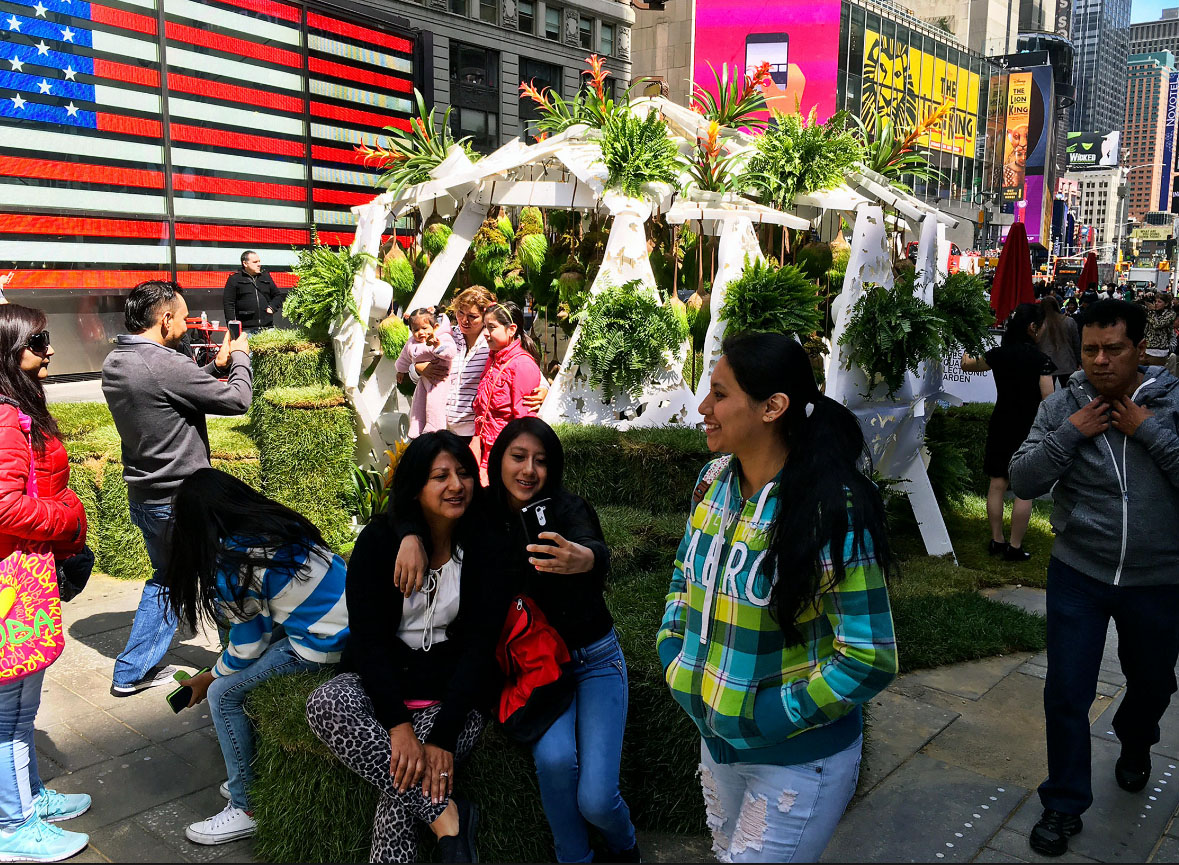
This article reviews the eco-social design work of students at the Gallatin School of Individualized Studies at New York University over the last decade. Environmental justice movements and the effects of global warming pose significant challenges to the architecture of dwellings, landscapes, and urban design communities. In response, students have placed socially and ecologically sensitive projects at the center of their design education. The justifiable moral outrage of our students has prompted us and them to rethink the methods by which we teach and imagine social environmentalism from the perspective of equity, inclusion, and the biosphere.
“Design Against Extinction at New York University,” with Mitchell Joachim, Spool, 10:1 (2023), 121-132. [PDF]
The Cooper Union Promotes Russian Architecture. Why?
The School of Architecture at Cooper Union promotes Soviet architecture in the midst of the Ukrainian Village in Manhattan. I argue that they should stop doing so, and instead support the war-torn nation. My opinions are in bold.
Statements by Ukrainians on Cooper Union’s Facebook page here (1/18/23).
Read my first op-ed here (1/21/23) and the version edited by Archinect here (1/25/23).
Read Cooper Union’s statements here (1/12/23), here (1/25/23), here (2/6/23) here (2/6/23), here (2/7/23), here (4/17/24) and here (4/17/23).
The reaction from Architect’s Newspaper here (1/26/23), here (2/2/23), and here (4/17/23).
The reaction from Archinect here (1/26/23) and here (2/7/23)
The reaction from ARTnews here (1/30/23) and here (2/7/23).
The reaction from Hyperallergic here (1/31/23).
The reaction from Dezeen here (2/2/23) and here (2/7/23).
Open letter in support of the Vkhutemas exhibition in Art and Education here (2/1/23).
Statement from PEN America here (2/2/23).
The reaction from Curbed here (2/6/23).
The reaction from Artforum here (2/6/23)
The reaction from The Art Newspaper here (2/6/23).
The reaction from New York Times here (2/7/23).
The reaction from Voice of America (in Russian) here (2/8/23).
The reaction from The Eastern Herald (India) here (2/8/23).
Read my answer to criticisms in an op-ed in Kyiv Post (Ukraine) here (2/8/23).
The reaction from Klassekampen (Norway) here or [PDF] (2/10/23) here (2/14/23), here (2/18/23), with my reply here and as PDF (2/24/23).
The reaction from Document (Norway) here (2/13/23).
Archiagape

Perhaps the architecture profession needs a new name? How about replacing “architecture” with “archiagape”? This is the lecture I gave at the Venice Biennale of Architecture in May 2021. Published as “Archiagape” in Ambiguous Territory: Architecture, Landscape and the Postnatural, Chris Perry (et.al.) (eds.), (Barcelona: Actar, 2022), 298-302. [PDF]
Ecology in Design: In Conversation
Ecology in Design: In Conversation with Nina Edwards Anker and Peder Anker.
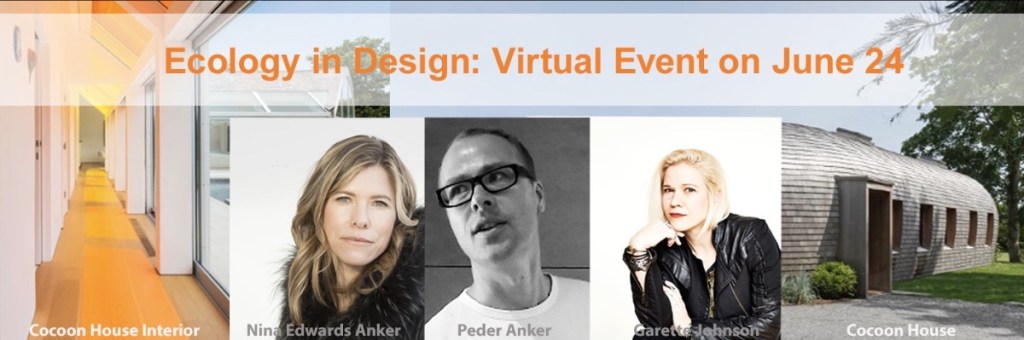
The American Scandinavian Society with Garette Johnson. June 24 2020.
GLOBAL Design NYU: Elsewhere Envisioned
 For the first time in its history, NYU’s Gallatin School of Individualized Study gathers leading-edge architects, designers, and theorists to address design issues that affect global ecology and the environment.
This exhibit of architectural models, drawings, animations, and projections, combined with a two-day symposium, brings together designers, scholars, and innovators to showcase design research as it relates to visionary architecture, landscape architecture, urbanism, and ecological planning.
Global warming effects pose new challenges to the architecture, landscape architecture, and urban design communities. The immediate response has been a turn toward a host of energy-saving technologies. What has rarely been addressed, however, is the problem of scale. How can the designer make sure that global solutions do not come at the expense of local traditions, cultures, and environments? By placing human rational, emotional, technological, and social needs at the center of our environmental concerns, we propose a new GLOBAL [Global Local Open Border Architecture and Landscape] design initiative.
We seek a Global yet still Local design that can Open the sociopolitical Borders that all too often separate Architecture from its Landscape. The overreaching aim is to develop a language of design that can create proximity between individual responsibility and the current global environmental crisis. We see environmental problems as a crisis of human alienation from the natural world, and our initiative will explore ways in which design can reformat the unfortunate separation. In our plea for proximity between the individual and the global we will explore, in the words of Maurice Merleau-Ponty, a design that is “as close to the beyond as to things near” when we evoke “our power to imagine ourselves elsewhere.”
GLOBAL DESIGN | ELSEWHERE ENVISIONED is directed and curated by Gallatin professors Peder Anker, Louise Harpman, Mitchell Joachim with support from the Gallatin Design Collective.
Sponsors include Susanne Wofford, Dean of the Gallatin School of Individualized Study, NYU Office of the Provost, Global Research Initiatives Program; NYU Office of Sustainability; Gallatin Community Learning Initiative; NYU Environmental Studies Department.
http://www.gdnyu.com/
Register | Event on Facebook | Facebook | Twitter | Blog


 Peder Anker