Posts filed under ‘Exhibitions’
Coding Plants
Coding Plants: An Artificial Reef and Living Kelp Archive
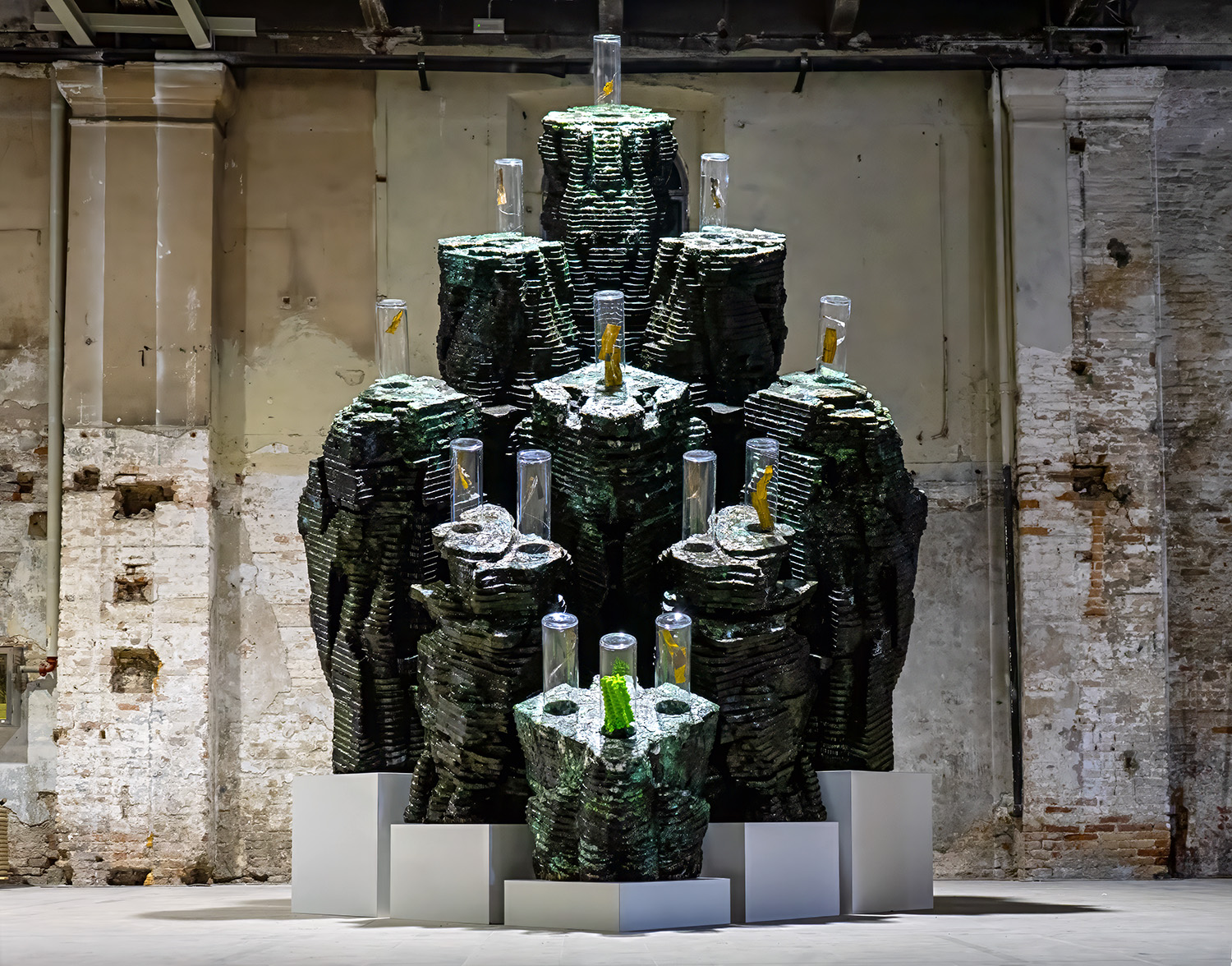
19th International Architecture Exhibition: Intelligens. Natural. Artificial. Collective.
Venice, May 10 – Nov. 23, 2025.
This is a neo-natural kelp reef where architectural records are transformed into edible proteins. Encased in air-tight vitrines, a collection of suspended, dried seaweed specimens showcases a transgenic process. Scientists have embedded encoded information—texts, images, and drawings—directly into the genetic material of this engineered vegetation, effectively turning the reef into a living, edible library. The 3D model at the center of the reef physically represents the phrase Form Follows Function, ciphered in the AGTC sequence of DNA. This exhibition is accompanied by the sound composition Earth Ocean, by Paul D. Miller aka DJ Spooky.
The title Coding Plants reflects our vision of embedding digital information into living systems to transform how we design and build. A single gram of plant DNA can theoretically store up to 215 million gigabytes of data. The project articulates a dual premise: the encoding of semantic and spatial information within botanical systems, and the broader implication of living matter as programmable infrastructure. While kelp is technically a macroalgae, not a plant, we use the term “plants” broadly—referring both to botanical life and to systems of production, as in “manufacturing plants.” Kelp serves as our transgenic prototype due to its ecological value and its potential for DNA-based data storage. The name signals a future in which living organisms—plant or otherwise—become computational, functional elements of architecture.
In the future, libraries won’t be built, but grown. Botanical organisms will be genetically augmented to store the knowledge of specific architectural forms—houses, bridges, communal spaces, and more—that can be extracted and used to challenge polluting construction methods. The goal is to design urban environments that adapt and evolve in balance with their surrounding metabolism. Plants will function as living archives, encoding detailed information within their DNA, allowing users to guide and influence their growth and structural form. This approach integrates radical sustainability directly into a semi-natural ecosystem, creating a harmonious blend of hybrid nature and human innovation.
Coding Plants is a synthetic living reef that serves as the ultimate archive of design knowledge. By embedding complex architectural intelligence into live organisms, Coding Plants proposes a climate positive agenda in which nature is empowered at the genetic level. While this vision may appear speculative, it is grounded in recent breakthroughs in genetic engineering. This approach heralds a fertile architecture that reimagines conventional building practices while fostering resilience, adaptability, and ecosystem integration.
Publications
“Coding Plants,” Intelligens. Natural. Artificial. Collective: Exhibition Catalogue, Carlo Ratti (ed.)(Venice, IT: Biennale Architectura, 2025), 100.
“Coding Plants” e-flux architecture, May 8, 2025.
Press
«20,000 Files Under the Sea,» NYU News, July 30, 2025.
“In Venice, an Architecture Biennale with a Dystopian Flair“, Architectural Record, May 30, 2025.
“Maybe Venice is the city that can save the world, BBC, May 26, 2025.
“Apre la Biennale di Venezia,” Interni, May 9, 2025.
“La mostra Intelligens,” Elle decor, May 10, 2025.
“Harvard Graduate School of Design Community Makes a Strong Showing at the 2025 Venice Architecture Biennale,” GSD News, May 9, 2025.
Credits
Project: Terreform ONE, Mitchell Joachim, Peder Anker, Melanie Fessel, Paul D. Miller (aka DJ Spooky). Studio: Vivian Kuan (Executive Director), Julie Bleha. Design: David Paraschiv, Emily Young, Sky Achitoff, Avantika Velho, JJ Zhijie Jin. Science: Sebastian S. Cocioba, Chris Woebken, Oliver Medvedik. Collaborators: Wendy W. Fok, WE-DESIGNS. Media: Michelle Alves De Lima. Research: Nicholas Lynch, Ava Hudson, Marina Ongaro, Jerzelle Lim, Helen Gui. Sponsors: U.S. National Endowment for the Arts, Global Research Initiatives, Office of the Provost, New York University. Global Design NYU, Gallatin School of Individualized Study, New York University. Oslo School of Architecture and Design. RheinMain University of Applied Sciences. Special Thanks: Carlo Ratti, Curator of the 19th International Architecture Exhibition. Victoria Rosner, Dean of Gallatin School of Individualized Study at New York University.
Design Against Extinction
This article reviews the eco-social design work of students at the Gallatin School of Individualized Studies at New York University over the last decade. Environmental justice movements and the effects of global warming pose significant challenges to the architecture of dwellings, landscapes, and urban design communities. In response, students have placed socially and ecologically sensitive projects at the center of their design education. The justifiable moral outrage of our students has prompted us and them to rethink the methods by which we teach and imagine social environmentalism from the perspective of equity, inclusion, and the biosphere.
“Design Against Extinction at New York University,” with Mitchell Joachim, Spool, 10:1 (2023), 121-132. [PDF]
Collapse: Climate, Cities & Culture Berlin


The COLLAPSE: CLIMATE, CITIES and CULTURE exhibition focuses on the design/artist community’s response to environmental urgency, using architectural models, design prototypes, drawings, and art to frame and advance this vitally important conversation. We will contrast and compare examples of design from central Europe to show efforts to find solutions for our current state of planetary peril. The practices and projects selected for this exhibition come from different disciplines and operate at multiple scales, in a range of forms—constructed works, materials and systems research, community development, and speculation. These diverse projects are joined by their shared focus on improving the health and well-being of our fragile planet and all of its occupants. Design will help to determine how we face our current and future collapse.
Berlin NYU at St. Agnes, Alexandrinenstraße 118
June 6-July 11, 2019.
Collapse: Climate, Cities & Culture
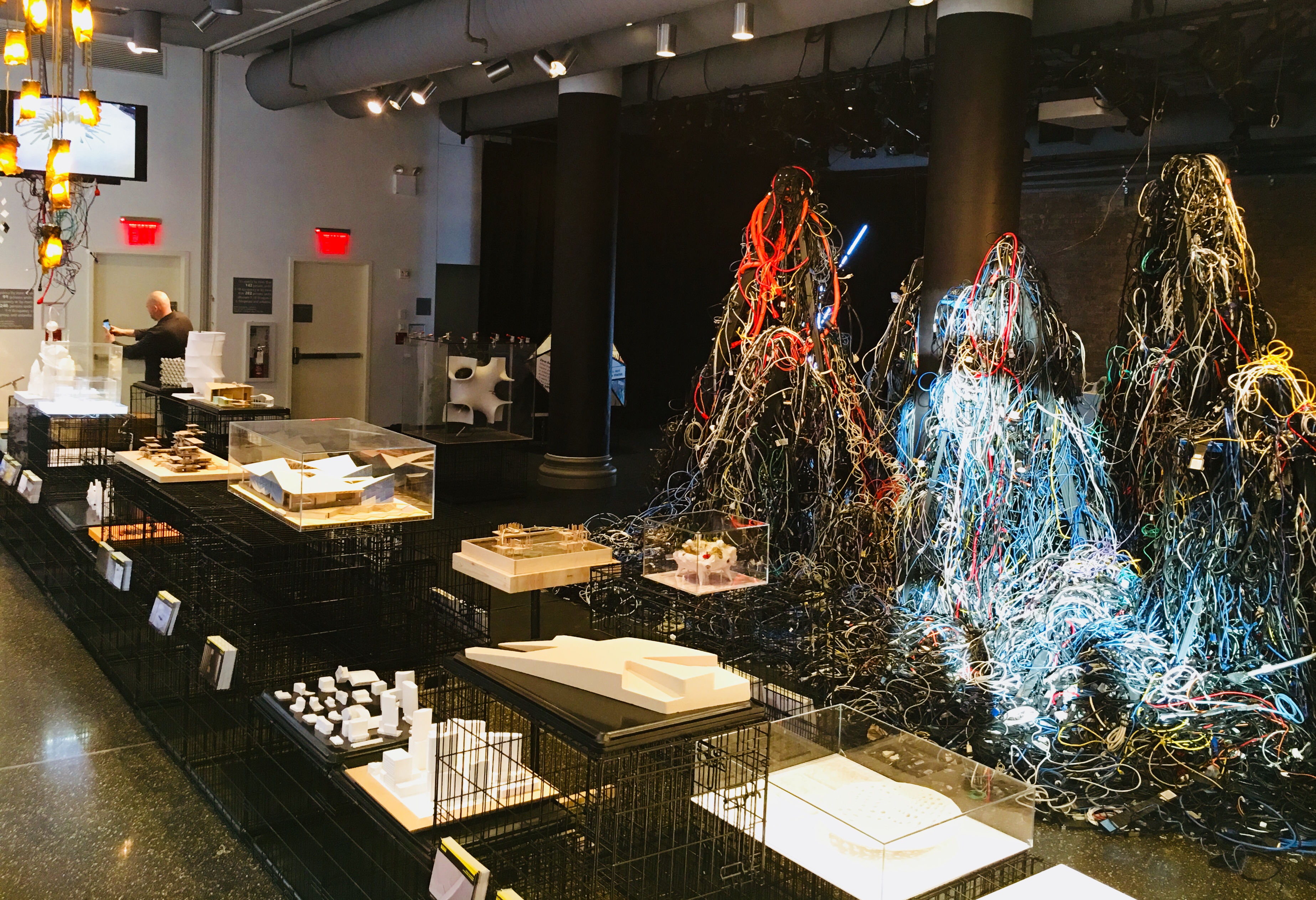
COLLAPSE: CLIMATE, CITIES & CULTURE focuses on the design community’s response to environmental urgency, using architectural models, design prototypes, drawings, and videos to frame and advance this vitally important conversation. COLLAPSE is not a dystopian future-scape, but is in fact our “right now.” The Directors of Global Design NYU believe that designers must join or initiate interdisciplinary efforts to find solutions for our current state of planetary peril.
COLLAPSE estimates that one species goes extinct every seven minutes and this rate may be up to 1000 times faster than evolutionary norms. In our exhibit design, the empty cages represent loss, or voids, in our natural world. They are like coffins for species whose graves we will never know, whose lives we will never learn about. The exhibit design also features over a ton and a half of e-waste, lent to us by environmental waste management company. E-waste (products with batteries or cords) contain poisonous heavy metals, chemical flame retardants, and polychlorinated biphenyls (PCBs). As our world becomes more interconnected, our production of e-waste is skyrocketing. Interconnectivity may save the planet in some ways, but its harm is already evident.
The practices and projects selected for this exhibition come from a myriad of disciplines and operate at multiple scales, in a range of forms—constructed works, materials and systems research, community development, speculation, and philosophy. These diverse projects are joined by their shared focus on improving the health and well-being of our fragile planet and all of its occupants. Design will help to determine how we face our current and future collapse.
The show featured contributions from more than thirty designers, including AGENCY, Alejandro Zaera-Polo, Alexander Felson, Anna Bokov, Anna Dyson, Archi-Tectonics, Architecture and Urban Design Lab, Axel Kilian, BiotA Lab, Carl Skelton, DESIGN EARTH, Experimental Architecture Group, Fernanda Canales, Forrest Meggers, Ghiora Aharoni Design Studio, Harrison Atelier, Jenny Sabin Studio, Julia Watson Studio REDE, Karen Holmberg, Maider Llaguno-Munitxa, Mark Foster Gage Architects, Mark Shepard and Moritz Stefaner, MASS Design Group, Mathur/Da Cunha, Mitch McEwen, NADAAA, nea studio, Nurhan Gokturk, Patrick Nash, pneumastudio/Cathryn Dwyre + Chris Perry, Rhett Russo, School of the Earth, SITE @ Princeton University, SO-IL, Terreform ONE, WXY, and Young & Ayata
Global Design NYU, Collapse: Climate, Cities & Culture, directed and curated by Peder Anker, Louise Harpman, Mitchell Joachim, The Gallatin Galleries NYC, June 12-29, 2018.
Seminar, Center for Architecture, 6-8pm, Oct. 3, 2018,
School of the Earth

Peder Anker and Mitchell Joachim (eds.) School of the Earth: Gallatin Reimagined in 2061, (New York: Gallatin School, 2017).
School of the Earth is a vision for what the Gallatin School of Individualized Study at New York University should be like in 2061 at Albert Gallatin’s 300th birthday. The envisioned new school is designed with our planet in mind. It is a school designed to fit the local ecosystem. This book was born from a dedicated class of students lead by professors Peder Anker and Mitchell Joachim. Humans have done enough taking, the students argue, and it is time to start giving back. Giving back to our planet and each other. The world is more connected than ever before and it is only going to become increasingly more intertwined and complicated. School of the Earth is about the necessity of connection, not only from human to human but between nature and people as well. The new vision for the Gallatin School is complete with visionary images and a model created to educate students and the public that not only is it possible for humans to exist while giving back, but that we can help make the planet a better, healthier place for the future as well.
The book, the exhibition, the model, a film, a published manifesto in Confluence, and the web site were the final results made by students of the class “Designing for New Climates: Histories of Adaptation” co-taught with Mitchell Joachim.
Get the book: US $ | GBP £ | EUR €
In the news: WSN and WSN editorial
Times Square Electronic Garden
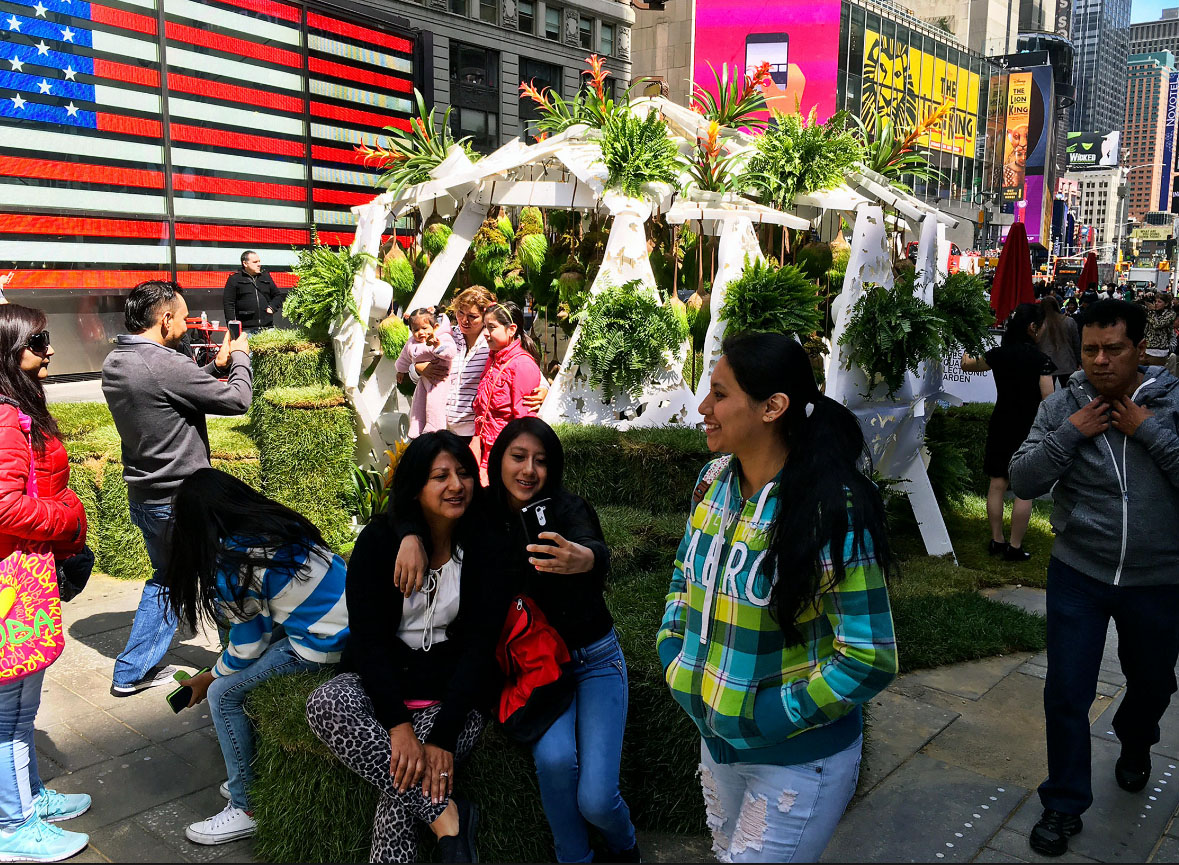
The “Times Square Electronic Garden” project initiated a conversation about climate change, energy use and green urban spaces. Designed and fabricated by New York University students, this earth bomb featured speakers and live sensors among the plants that connected to our URL. The idea was to “re-nature” Times Square so that the public can contemplate new natures within our cities. We invited people to explore soothing living vegetative surfaces and recognize the stark contrast of their hyper-electrified surroundings. The students designed and built an open central sphere for visitors to circulate through so that they could encounter a microcosm of hanging gardens. Around the sphere we created a greenscape of serpentine living benches for rest, gathering, and contemplation. The whole project, start-to-finish, was erected and removed in a 24 hour period on May 10th, 2016. It was a place to reimagine Times Square’s consumer culture into a truly sumptuous environmental future.

Co-Principal Investigators: Mitchell Joachim, Louise Harpman, Peder Anker. Film Media: Keith Miller. NYU ITP: Namira Abdulgani, Kylin Chen, Ella Dagan, Jordan Frand, Michelle Hessel, Renata Kuba, Gal Nissim, Isabel Paez, Tigran Paravyan, Lutfiadi Rahmanto, Leslie Ruckman, Abhishek Singh, Edson Soares, Katie Temrowski, Jed Watson, Yan Zhao, Yang Zhao. NYU Gallatin: Theo Mandin-Lee, Jordan Marks, Max Mezzomo, Valerie Mu, Shel Orock, Alex Selz, Henry Wang. NYU Staff: Karim Ahmed, Jenny Kijowski, Nicholas P Likos, Lillian J Warner, Matthew Tarpley, Shandor Hassan, Shai Pelled.
Sponsored by: GDNYU, NYU Gallatin School, Times Square Alliance, NYCxDESIGN, NYU Tisch.
TechStyles: The Gallatin Fashion Show

TechStyles: The Gallatin Fashion Show will offer an examination of how fashion is inspired by science and technology, with sixteen collections from Gallatin students and alumni. TechStyles: The Gallatin Fashion Show will feature looks that take some heat from Steampunk, find God in the machine, suit up for Utopia, as well as offering meditations on stardust and bioluminescence and other phenomenon of the natural world. Q&A: Colby Jordan and Peder Anker.
Mar. 3 | 7:00 – 9:00 PM | The Jerry H. Labowitz Theatre for the Performing Arts | Gallatin School of Individualized Study, 1 Washington Place, New York.
Envision: Nature and Design

ENVISION: Nature and Design, sponsored by Global Design NYU, creates an exciting dialogue with many disparate and active researchers within the Gallatin community, as we look to broaden the horizons on the meanings of Nature and Design.
The event is a structured presentation format where presenters show 20 images, each for 20 seconds. The images advance automatically to coordinate with the speaker, creating a fast-paced and lively environment for showcasing current work. Powered by PechaKucha.
With Jack Richards, Jack Tchen, Katherine O’Kelly, Carly A Krakow, Matt Stanley, Marie Cruz Soto, Lauren M Walsh, Anooradha Iyer Siddiqi, Fran White, Leila Buck, Judith Sloan, Piper Anderson, Frederic Clark, Carter Bird, and Karen Holmberg. Organized by Peder Anker, Mitchell Joachim and Louise Harpman.
Behind the Green Door: A Critical Look at Sustainable Architecture
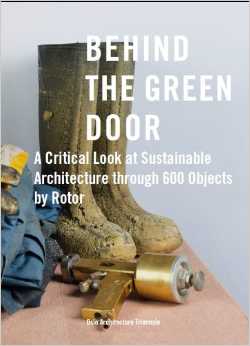 “Comments” in Behind the Green Door: A Critical Look at Sustainable Architecture through 600 Objects by Rotor, (Oslo: Oslo Architecture Triennale, 2014), 27, 169, 178, 203, 210, 214.
Download PDF with my comments here.
Behind the Green Door: A Critical Look at Sustainable Architecture through 600 Objects portrays the prevailing green wave in architecture and the many controversies that surround it. The book is enriched with comments from over 100 international experts.
Cities and Citizenship Symposium

Architects, sociologists and environmentalists explore the intersection between design and the social sciences at large by explicating the concept of “city” and “citizen” in parallel. Cities and Citizenship is a three-day symposium, consisting of a conference series and workshops, that explores how the design of cities can promote a more engaged citizenry. The event will engage leading designers, architects, landscape architects, planners, urbanists, historians, and scientists.
Cities and Citizenship is co-sponsored by the Goethe-Institut New York, Parsons The New School for Design, NYU Gallatin School of Individualized Study and Global Design NYU. The symposium is organized by Alissa Burmeister from the Goethe-Institut New York, Ioanna Theocharopoulou from Parsons The New School for Design, Peder Anker, Louise Harpman, Mitchell Joachim, from Global Design NYU at Gallatin School of Individualized Study, New York University, and is part of the Goethe-Institut’s international Weltstadt: Who Creates the City? initiative.
MARCH 13-15, 2014. DOWNLOAD PROGRAM. All events are free and open to the public. Seating is limited. Please register with wyomingbuilding@newyork.goethe.org by March 12th.
Participants include: Peder Anker, [History of Science, Gallatin School, NYU], Gianpaolo Baiocchi [Sociology, Director of Civic Engagement, Gallatin School, NYU], Matthias Böttger [Architect + Curator, Raumtaktik, Berlin], Susannah Drake [Landscape Architect, dlandstudio], Stephen Duncombe [Sociology, Gallatin School, NYU], Louise Harpman [Architecture, Gallatin School, NYU], Matthias Hollwich [Architect + Co-founder, HWKN], Natalie Jeremijenko [Fine Art + Environmental Studies, NYU], Colin Jerolmack [Environmental Studies + Sociology, NYU], Mitchell Joachim [Architecture, Gallatin School, NYU], Eric Klinenberg [Sociology, NYU], Victoria Marshall [Landscape + Urban Designer, Parsons], Brian McGrath [Architecture, Dean, School of Constructed Environments Parsons], Miodrag Mitrasinovic [Architecture + Urbanism, New School], Mariana Mogilevich [Architecture + Metropolitan Studies, NYU], Vyjayanthi Rao [Anthropology, New School], Eric Sanderson [Senior Conservation Ecologist at WCS], Saskia Sassen [Sociology, Columbia University], Susanne Schindler [Architecture, New School, Candide Journal], Ioanna Theocharopoulou [Architectural History, Parsons], Tyler Volk [Biology + Environmental Studies, NYU], Lynnette Widder [Earth Institute, Columbia University].
Review: Carly Krakow, Peder Anker, Louise Harpman, Mitchell Jocahim, “Cities and Citizenship: Notes from the Conference,” Weltstadt Zeitung, no. 5, April 30, 2014, 3.


 Peder Anker